
written by Derick Greyling
33 And they said to him, “The disciples of John fast often and offer prayers, and so do the disciples of the Pharisees, but yours eat and drink.” 34 And Jesus said to them, “Can you make wedding guests fast while the bridegroom is with them? 35 The days will come when the bridegroom is taken away from them, and then they will fast in those days.” 36 He also told them a parable: “No one tears a piece from a new garment and puts it on an old garment. If he does, he will tear the new, and the piece from the new will not match the old. 37 And no one puts new wine into old wineskins. If he does, the new wine will burst the skins and it will be spilled, and the skins will be destroyed. 38 But new wine must be put into fresh wineskins. 39 And no one after drinking old wine desires new, for he says, ‘The old is good.’”
–Luke 5:33–39ESV
In the middle of a series of confrontations with the Pharisees and teachers of the Law, Jesus is challenged about why His disciples don’t fast. The Pharisees were rigid in their traditions — people who followed their own legal systems, performed acts of piety to be seen by others, and wore their “holiness” like a badge of honour. Their question opens the door to one of Jesus’ famous parables.
“Can you make the friends of the bridegroom fast while he is with them? But the time will come when the bridegroom will be taken from them; in those days they will fast.”
-Luke 5:34-35

Jesus the Bridegroom
Jesus responds to them by referring to Himself as the Bridegroom — and the time of His presence among them as a wedding celebration. This isn’t the only place in Scripture where this image appears. We find it in Isaiah 62:5, John 3:29, and Revelation 21:7–9. The message is clear: His presence is an occasion for joy, not fasting. Yet He also hints at what is to come — a day when the Bridegroom would be taken away, and a time we still find ourselves living in.
The Parables
Jesus then tells a parable using two familiar pictures from everyday life in first-century Palestine — patching a garment and storing wine.
The garment
Old cloth vs new patch
You can’t sew a piece of new cloth onto an old garment. The new patch tears away, and the gap is worse than before. The new doesn’t fit the old.

The wineskin
New wine vs old skin
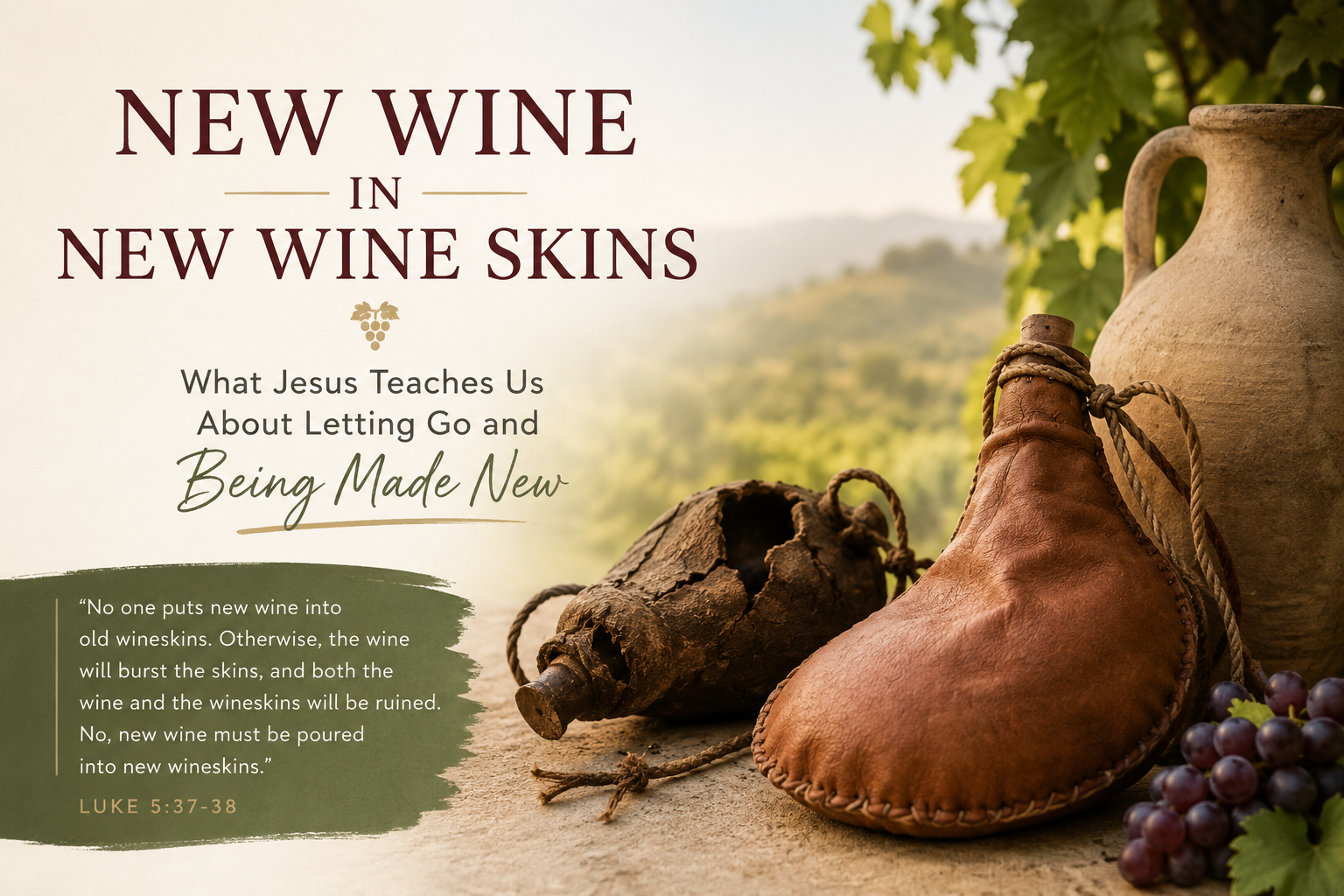
New wine, still fermenting, will burst an old brittle wineskin. Both the wine and the skin are lost. New wine requires a wineskin with enough elasticity and strength to expand.
Wineskins were made from animal hides — usually goat or sheep skin — treated with salt and minerals to preserve them. Over time, they lost their flexibility and became rigid and brittle. A new skin could handle the pressure of fermentation; an old one simply could not.
“New wine must be poured into new wineskins. And no one after drinking old wine wants the new, for they say, ‘The old is better.’”
What Does This Mean for Us?
Jesus came to fulfil, not abolish
It’s important to note that Jesus didn’t condemn fasting — He simply explained that the timing was wrong. In the same way, He didn’t come to abolish the Law but to fulfil it. As He says in Matthew 5:17, He came to give the Law its full meaning. He became the bridge between the old covenant and the new.
The new life doesn’t fit the old one
The new life we have in Jesus simply doesn’t fit the old life we lived before Him. Ephesians 4:22–24 puts it plainly:
“To put off your old self, which belongs to your former manner of life and is corrupt through deceitful desires, and to be renewed in the spirit of your minds, and to put on the new self, created after the likeness of God in true righteousness and holiness.”
— Ephesians 4:22–24ESV
You are the wineskin
The new wine represents the Spirit and the work God wants to do in your life. And you are the wineskin. An old wineskin is rigid, brittle, and has lost its elasticity. A new wineskin is flexible — able to stretch, to bear the pressure of the transformation happening within it.
Notice something tender in the parable: God doesn’t just speak of saving the wine or saving the skin separately. Verse 38 says both are preserved together. God cares so deeply about you — not just what He wants to pour into you, but you yourself. He gave His only Son so that you could be made new and be kept.

So, What Does This Look Like in Practice?
Three practical steps
1. Accept Jesus as your Saviour and Lord.
He didn’t come to patch up your old life — He came to make you entirely new. As 2 Corinthians 5:17 says: “If anyone is in Christ, the new creation has come: the old has gone, the new is here.”
2. Break with the old life.
Paul describes this beautifully in Philippians 3 — counting everything he once valued as loss compared to knowing Christ. What once seemed like gain, he came to see as rubbish. This kind of reorientation is what makes room for the new.
3. Don’t resist what God wants to do in you.
Like new wine fermenting in a wineskin, transformation is a process — often uncomfortable, strange, and uncertain. Romans 12:1 calls us to offer ourselves as living sacrifices. Don’t look back at the old life with longing. As Jesus says in Luke 9:62, no one who looks back while holding the plough is fit for the kingdom of God.
A Closing Thought
Jesus offers us new wine. But He cannot pour it into old wineskins. When we cling to old habits, old sins, and trust in ourselves alone, we miss the fullness of what God wants to do in our lives. The price for our renewal has already been paid — by the blood of Jesus.
Maybe you’re tired of trying to patch things together. Maybe you feel drained, no matter what you do. Maybe there’s a hollow space inside you that nothing seems to fill. Or perhaps you once felt full, but something has burst, and you’re left gathering the pieces.
This is your moment. Not to patch the old — but to be made entirely new. You can pray the following prayer:
Lord Jesus
Thank You that You didn’t come to patch up the old — You came to make all things new. Right now, I choose to stop holding on to what was, and I open my hands to receive what only You can give.
I confess that I need You. Not as a last resort, but as my Lord and Saviour. I believe You died for me, that You rose again, and that Your blood has already paid the price for my renewal and my salvation.
Today, I choose You. Pour Your new wine into me. Make me the kind of vessel that can hold everything You have planned for my life.
I lay down the old life — the old habits, the old hurts, the old ways of doing things on my own. I pick up this new life, not because I have it all figured out, but because I trust in You – the One who does.
Jesus, You are enough. You have always been enough.
Amen.
*A portion of this blog post was outlined and edited with the assistance of AI.